
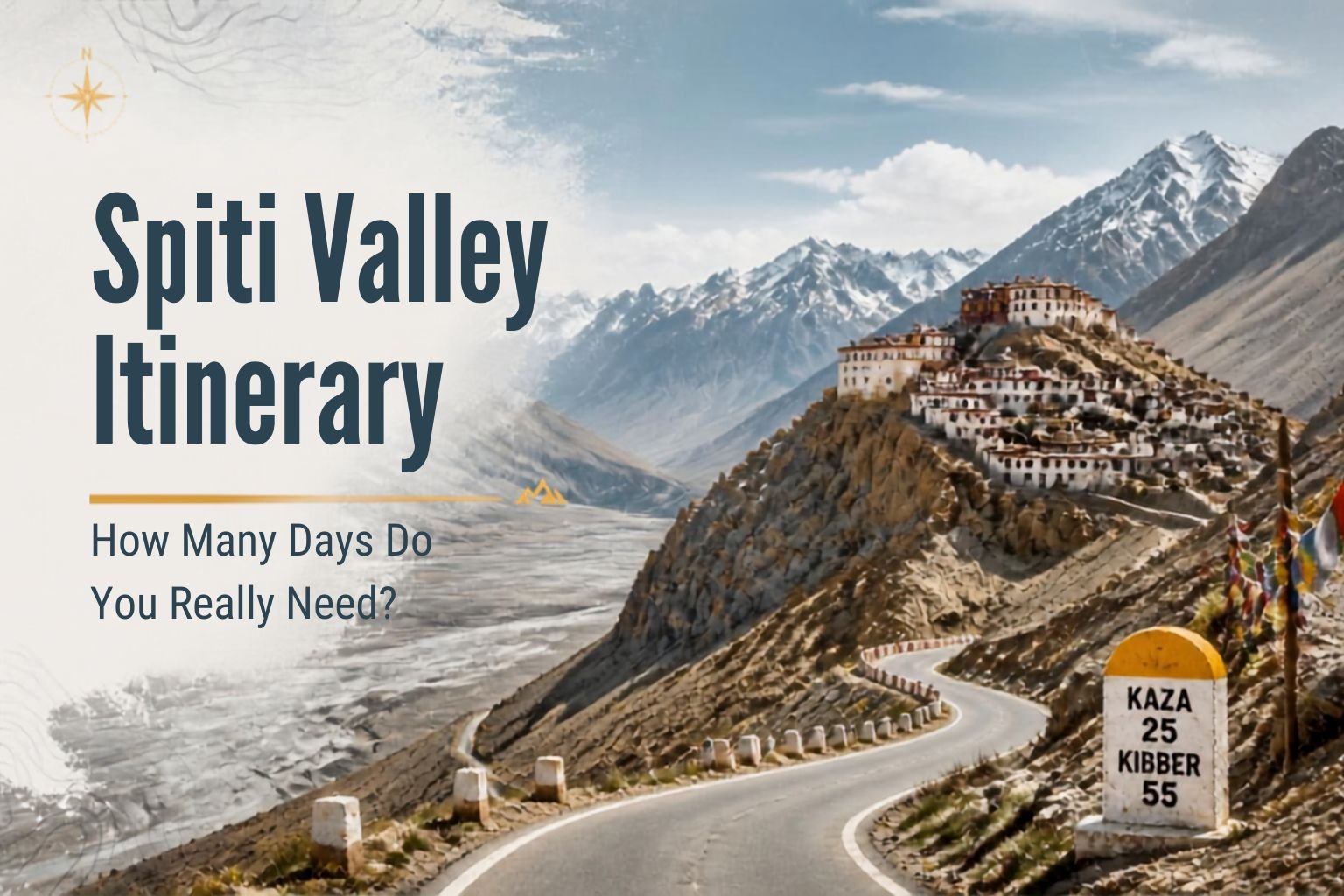
Quick Answer
Most travelers need 7-9 days for a proper Spiti Valley trip, including acclimatization, since the region sits between 3,000-4,550m and long mountain drives eat up entire days. A 6-day trip works if the acclimatization risk isn’t a concern, while a 9-10 day Shimla-Kinnaur-Spiti-Manali circuit is ideal if you want to add Chandratal Lake and Kinnaur’s villages. The best time to visit is mid-June to early October when the Manali-Kaza road is open; Indian citizens need no permit, but foreigners need a Protected Area Permit for stretches near the Tibet border.
Why Spiti Valley Doesn’t Fit a Standard Weekend Itinerary
Spiti Valley is often called a “cold desert” for good reason — it’s a high-altitude Himalayan region in Himachal Pradesh bordering Tibet, with a landscape closer to Ladakh than to the green hill stations most people associate with Himachal. What makes planning Spiti different from, say, a Shimla-Manali trip is distance and altitude combined: villages here are spread far apart, roads are narrow and slow, and altitude gain needs to be managed carefully to avoid sickness. A rushed 4-day Spiti trip almost always means spending more time in the car than actually seeing the valley.

Altitude and Geography – What You’re Dealing With
- Kaza (Spiti’s main town): ~3,650m (11,811 feet)
- Key Monastery: ~4,166m
- Kibber village: ~4,270m (one of the highest motorable villages in the world)
- Komic village: ~4,587m
- Chandratal Lake: ~4,300m
- Kunzum Pass: ~4,551m (the gateway between Spiti and Manali)
Because most of Spiti sits above 3,500m, altitude sickness is a genuine consideration here too — not just in Ladakh. Spend your first night at a lower point in the valley (Kalpa or Tabo rather than pushing straight to Kaza) if you’re prone to AMS.
Best Time to Visit Spiti Valley
- Mid-June to September is peak season — the Manali-Kaza road (via Kunzum Pass) is open, weather is stable, and all villages are accessible.
- September to early October offers clearer skies, golden landscapes, and noticeably fewer tourists.
- October to May, Kunzum Pass and the Manali route close due to snow; Spiti becomes accessible only via the longer Shimla-Kinnaur route. Winter Spiti is stunning but only for experienced, well-prepared travelers.
Spiti Itinerary Options – Choosing the Right Length
6 Days: The Minimum Viable Spiti Trip
Suitable if you’re flying into Kullu-Manali airport and starting the loop from Manali. Covers Kaza, Key Monastery, Kibber, and a quick stop at Chandratal, but doesn’t leave much room for remote villages like Langza or Komic. Only recommended if you’re short on time and comfortable with a faster pace.
9 Days: The Sweet Spot for Most Travelers
- Day 1-2: Delhi/Chandigarh to Shimla to Kalpa (Kinnaur), with a night to acclimatize
- Day 3: Kalpa to Tabo, visiting Nako village en route
- Day 4: Tabo to Kaza, exploring Tabo Monastery before departure
- Day 5: Kaza local sightseeing — Key Monastery, Kibber, Chicham Bridge
- Day 6: Kaza to Langza, Komic, and Hikkim (the world’s highest post office), back to Kaza
- Day 7: Kaza to Chandratal Lake via Kunzum Pass
- Day 8: Chandratal to Manali
- Day 9: Manali sightseeing or departure
10-11 Days: The Complete Kinnaur-Spiti Circuit
Adds Sangla Valley and Chitkul (the last inhabited village near the Indo-Tibet border) to the above, giving you the fullest possible picture of the region without rushing any single stop. This is the version we’d suggest if Spiti is likely to be a once-in-a-few-years trip rather than something you’ll repeat.
Which Route Should You Take – Manali or Shimla-Kinnaur?
- Manali to Spiti (via Kunzum Pass): Shorter and more commonly used, but the pass is only open roughly June to October and can be affected by weather even in season.
- Shimla-Kinnaur to Spiti (via Sumdo): Longer but more scenic, passing through Sarahan, Sangla, Kalpa, and Nako before reaching Kaza. Usable slightly outside the core Spiti season since it doesn’t depend on Kunzum Pass.
- The classic loop: Many travelers enter via Shimla-Kinnaur and exit via Manali (or vice versa), avoiding backtracking and seeing both approaches in one trip.
Permits for Spiti Valley
Here’s the part that confuses most travelers, so let’s simplify it:
- Indian citizens do not need any permit for standard Spiti Valley tourism — Kaza, Key, Tabo, Dhankar, Kibber, Langza, Komic, and Chandratal are all open with just a valid photo ID (Aadhaar, driving licence, or passport) for checkpost registration at Jangi and Sumdo.
- Foreign nationals need a Protected Area Permit (PAP) for certain stretches near the Tibet border, including parts of the route toward Sumdo, Gue, and Chango. Sections like Kaza-Tabo-Dhankar-Komic-Langza-Hikkim and Kaza-Losar-Kunzum Pass-Manali typically do not require a PAP, but border-adjacent villages do.
- Where to apply: Foreigners can obtain the PAP from the SDM office in Reckong Peo (Kinnaur) or through a registered travel agent; there’s no online application system for this permit as of now.
- Official reference: the Lahaul & Spiti district administration’s foreigner information is available at hplahaulspiti.nic.in.
- A separate small SADA (Spiti Area Development Authority) vehicle fee applies at entry checkposts for all vehicles, Indian and foreign alike — this is a local development charge, not a permit.
What to Carry for Spiti Valley
- Warm layers for every season — nights stay cold even in July and August
- Sunscreen and sunglasses — UV intensity is high at this altitude
- Cash in small denominations, since ATMs are unreliable beyond Kaza
- A basic medical kit, including any AMS medication your doctor recommends
- Offline maps downloaded in advance — mobile network is patchy through most of the valley
- A powerbank, since electricity supply can be inconsistent in remote villages
Solo Travel vs Group Travel in Spiti
Solo travelers (especially bikers) should stick to daylight driving hours, inform someone of their daily route, and carry extra fuel where possible, since petrol pumps are sparse beyond Kaza. Spiti is generally safe for solo travel on well-used routes, but the remoteness means help can be far away if something goes wrong.
Group or guided travel is often the more practical choice here — shared vehicle costs make the long drives more affordable, and local drivers familiar with the terrain and weather patterns can make faster, safer calls about route changes when passes close unexpectedly.
Final Thoughts
The honest answer to “how many days does Spiti need” is: more than most people initially plan for. A 9-day Shimla-Kinnaur-Manali loop gives you enough time to actually experience Spiti’s monasteries, villages, and landscapes without every day being consumed by driving. If your schedule only allows 6 days, it’s still worth doing — just keep expectations realistic about how much ground you can cover.
Royal Rover Holiday’s Spiti Valley tour packages are built around exactly these itinerary lengths, with acclimatization built into the schedule and experienced drivers who know the Kinnaur and Manali routes well.
Some Relevant Pages
- Spiti Valley Tour Packages — our full range of Spiti itineraries
- Spiti Valley Road Trip Package (9N/10D) from Chandigarh — matches the 9-day itinerary in this guide
- Spiti Valley Manali Road Trip Package (9N/10D) from Delhi — the Manali-entry version of the same circuit
- Spiti Valley Tour Package from Delhi (10N/11D) — the complete Kinnaur-Spiti circuit
- Kinnaur Tour Package from Delhi — if you want to focus on Sangla and Kalpa separately
Relevant Blogs
- A Practical Guide to Visiting Himachal Pradesh This Season (2026)
- Spiti Valley: A High-Altitude Haven in the Himalayas
Frequently Asked Questions
How many days are ideal for a Spiti Valley trip?
9 days is the sweet spot for most travelers, covering Kinnaur, Kaza, the surrounding villages, and Chandratal without rushing. A minimum of 6 days works if you’re short on time.
Do Indian citizens need a permit to visit Spiti Valley?
No. Indian citizens need only a valid photo ID for checkpost registration at Jangi and Sumdo; no Inner Line Permit or Protected Area Permit is required.
What is the best time to visit Spiti Valley?
Mid-June to September is peak season with the Manali-Kaza road open; September to early October offers clearer skies and fewer crowds.
Should I enter Spiti via Manali or via Shimla-Kinnaur?
Manali is shorter but depends on Kunzum Pass being open (roughly June-October). The Shimla-Kinnaur route is longer but more scenic and usable slightly outside peak season; many travelers combine both directions in one loop.
9 Weekend Trips from Chandigarh Under 6 Hours, Ranked by Actual Drive Time
Quick Answer The nine best weekend getaways from Chandigarh within a six-hour drive are Morni Hills (1 hr 30), Kasauli (1 hr 45), Solan and
Chandigarh to Manali by Road in 2026: Real Drive Times, Four-Lane Status and Where to Stop
Quick Answer Chandigarh to Manali Tour is roughly 290 km by road. Since the Kiratpur–Nerchowk four-lane opened in March 2024, a clean off-season run takes
5-Day vs 7-Day vs 10-Day Himachal Itinerary: Which One Fits Your Time & Budget
Quick Answer A 5-day trip suits a single circuit like Shimla-Manali and works well for a quick escape or a tight budget. 7 days is